
Surviving a Picher, Oklahoma Tornado: A Little League Miracle
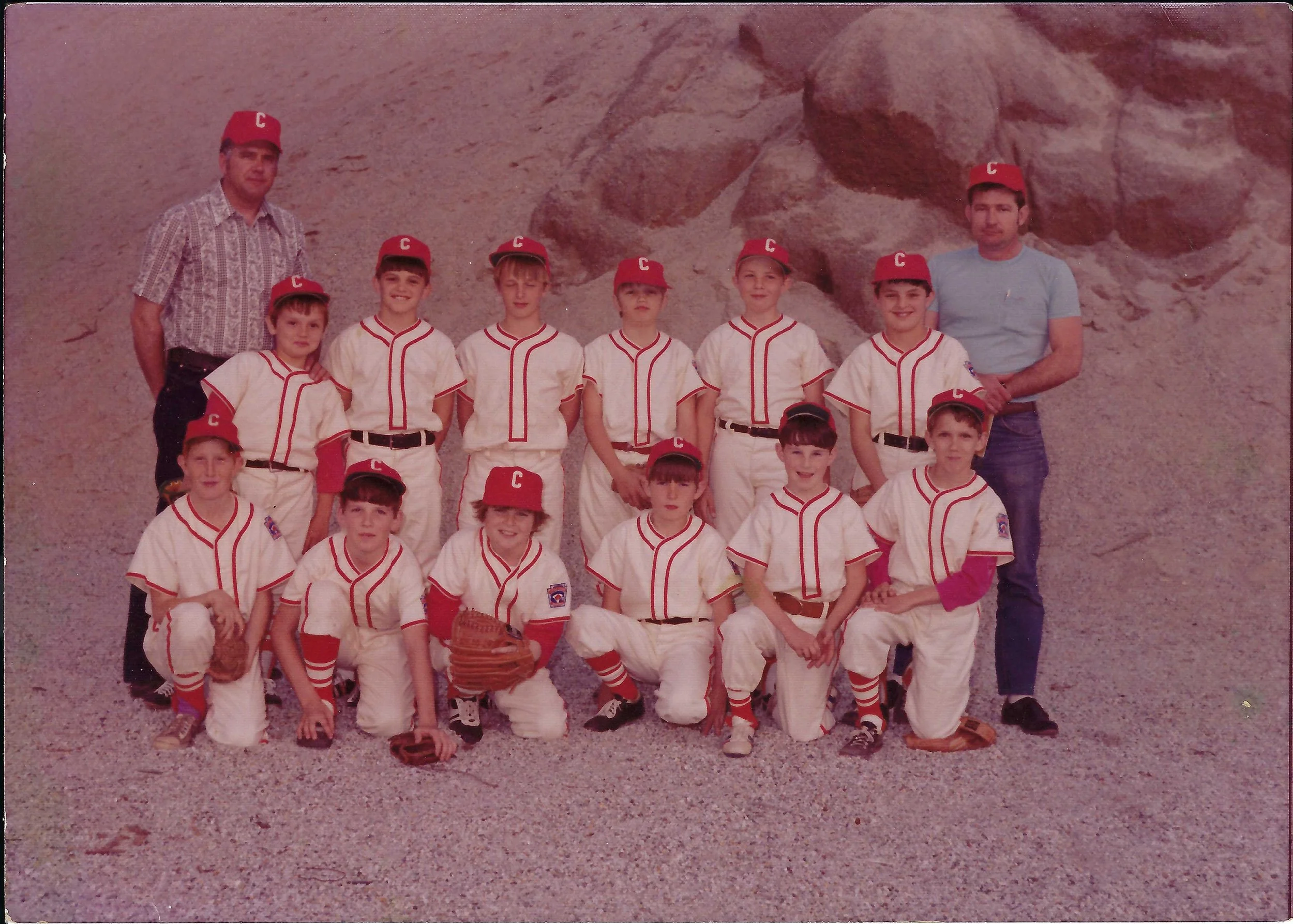
That’s me in the back row, far right with a big smile on my face. I had just bounced one off the scoreboard in centerfield before this picture was taken. Guess the tornado wasn’t the only big hitter at the park that season. And yeah, that’s what a chat pile looks like up close.
The Day a Toxic Chat Pile Shielded a Little League Team from Disaster
Our Little League field sat right at the base of one of the largest chat piles in Picher, Oklahoma. To folks around town, it was just part of the scenery—nothing special. Chat piles were everywhere. Kids played on them like jungle gyms, and no one thought twice. Parents in the stands barely noticed when younger siblings wandered up the side of a 20-story mountain of crushed rock. That was just life in Picher.
The ballpark parking lot, naturally, was made of chat. Some folks might call it gravel, but around here, it was just “chat,” and it got into everything. Your shoes, your glove, your sunflower seeds. It clung to you like the town itself, coating every inch, watching every move. If the wind kicked up during a game, it’d even dust your snow cone with a little crunch.
Game Day Vibes
It was late spring. Hot. Sticky. The season was winding down, and every kid on the field was giving it all they had. All-Star rosters were on the line. Coaches were making quiet notes. Parents were out in full voice. You could always hear Anna Lue above the crowd: sharp, supportive, and unfiltered. You didn’t even have to know whose kid she was cheering for. You just knew she meant it.
You could smell the fresh-mowed grass from the outfield and taste the dusty sweat running into your mouth. Catcher’s mitts popped with the sharp snap of a fastball. Aluminum bats rang out like church bells every time somebody connected. The snack shack rattled off hot dogs and Frito pies. And under it all, that constant Oklahoma hum: the buzzing insects, the far-off bark of a dog, the low whisper of wind curling around the chat piles like it had somewhere better to be.
That evening, the sun was still up but beginning to fade when the clouds rolled in. Nobody in Oklahoma flinched. We’d all seen storms roll across the horizon. Some passed over with a sprinkle. Others cracked the sky open. But unless there were sirens, the game went on.
Picher, Oklahoma Tornado Unleashed
The sky dimmed. A dry wind swept across the outfield. Then, without warning, a funnel cloud tail dropped out of the clouds and touched down—right on top of the chat pile.
At first, it was almost beautiful. A thin, twisting rope of cloud reaching for the earth, trailing dust like a finger dipped in flour. We all squinted toward it—moms, dads, kids, coaches—half stunned, half curious.
Then it exploded.
Tornado Baseball Chaos
Loose chat erupted into the air like a volcanic blast. Chat and dust flew skyward, caught in the spinning column and flung in every direction. The sound was unbelievable: like the sky had swallowed a gravel truck. Chat rained down across several blocks, cracking windshields, breaking windows, denting cars and rooftops. The scoreboard in deep center field sounded like popcorn popping. The tin roof of the dugouts rang out like a chorus of handbells as the chat ricocheted off, rattling and spraying like a machine gun.
I remember standing there for a second, frozen. The bat slipped out of my hands without me even noticing. Kids screamed. Moms yanked toddlers off the bleachers. Coaches hollered, waving everyone toward the dugouts and the block concession stand. But no one knew what to do, really. There was no drill for “giant gravel tornado.” No practice sessions for “tornado baseball” games.
Chat Pile Saves Tornado Baseball Game
The debris flew high above us, the angle of the funnel launching most of the chat overhead instead of straight at us. If that thing had touched down fifty yards closer, it would’ve torn through the ballpark like a saw blade through balsa wood. But the people in the ballpark? We were spared. Because we were too close to the pile. The angle of the funnel sent the debris over our heads—launched like shrapnel but aimed too high. What could’ve been a tragic day at the diamond became a story we’d tell for years. Jaws dropped at how close we came.
Moms clutched kids in dugouts. Dads stood with arms spread like human shields. Somebody’s nachos flew halfway across the stands. And somewhere, behind all the commotion, the faint buzz of the PA announcer crackled, still trying to call balls and strikes like nothing had happened.
The Dust Settles: Surviving a Picher, Oklahoma Tornado
When it was clear the worst had passed, everyone just kind of stood there, stunned. Covered in a light dusting of chat. Picking pebbles out of hair, shaking it out of ball caps, blinking grit from their eyes.
That chat pile—a monument to the industry that poisoned the ground and doomed the town—shielded us that day. A guardian made of dust. It was like the pile came alive, a giant mother hen spreading her dusty wings to shield her chicks. For once, Picher was taking care of Picher, even if one of the players was an inanimate mountain of mining waste. It was almost poetic. The pile that had slowly hurt us had also protected us in a moment of brute force. It didn’t save Picher from what was coming, but it gave us a glimpse of grace that day.
We knew that chat pile better than we knew some of our own cousins. We climbed it, slid down it, built forts in its gullies, sledded down its snowy face in winter on busted-up pieces of Formica. We scraped knees, busted knuckles, tore blue jeans, and came home looking like miners ourselves: filthy, grinning, exhausted.
That day, it gave us something else: a second chance.
Picher Tornado 2008
Years later, a much bigger storm came back. In 2008, an EF5 tornado cut through Picher with a kind of surgical violence. It didn’t spare the town. By then, most families had already left, relocated by the EPA after decades of mining damage and lead contamination. That tornado didn’t care that the town was already dead. It came anyway—like a final exhale.
I remember driving through what was left. Empty slabs where homes once stood. But sometimes, something was left—something haunting. Closets, still upright, with clothes hanging neatly. Doors ajar. A red sweater swaying on a plastic hanger. A bathroom standing alone, four porcelain walls around a tub that had outlived everything else. Trees stripped of bark, trucks flipped and folded, chimneys with nothing to warm. That was the final blow. The tornado that came back to finish what the first one started. My soul ached at the devastation and misery wrought on my friends and former classmates. Once a resident of Picher, always a resident of Picher. My heart hurt.
We grew up in tornado alley USA. We knew what tornadoes look like. We thought we understood storms. We laughed at sirens, watched the sky with practiced eyes. We thought we were tough. Unshakeable. Invincible. We thought we were bulletproof. But that day reminded us—we weren’t. Not really. None of us were. And yet, somehow, we were spared.
Tornado Baseball Game Hero
That day at the ball field, the chat pile was our protector. Just that once, it stood tall and caught the brunt of the storm for us. A dusty, toxic giant—doing something noble at the end of its reign. We didn’t come away unshaken. But we walked away.
Later that night, when the shock wore off, we found chat pebbles in our shoes, our socks, even our bedsheets. We’d shake our heads and laugh, half at the absurdity, half at the fact that we were still alive to laugh at all. Another scar layered onto the story of Picher. Another memory ground into our bones like the chat in our hair.
We weren’t bulletproof.
But we were barefoot, dust-covered, and still standing.
And sometimes, that’s enough.
And in the end, we lived to tell the tale.
🎥 A Ghost Town From Above: Picher, Oklahoma Now
Picher, along with nearby Tar Creek, is now an EPA Superfund site. The government relocated all residents, tore down every building, and barricaded most of the streets. What they left behind, an EF5 tornado finished off. Today, nothing remains but cracked pavement and overgrown weeds. Trees reclaim the grid of a once-bustling town. Population: zero.
The Los Angeles Times called Picher “The Most Toxic Town in America.”
But to us? It was just home.
This drone footage shows what remains.
Aerial views of Picher, Oklahoma
At 0:25, look to the end of the road on the right. That’s where our house once stood—at the base of the Sooner chat pile, the largest in Ottawa County when we were growing up. It stood 20 stories tall then. It’s only a shell of itself now.
At 1:50, the camera hovers over the old ballfield.
I don’t recall the name of the chat pile beside it—but it was a giant itself back then.
And that day, it saved us.
The town is gone. The scars remain. But the stories endure.
💬 If this story hit you hard, let it hit someone else too.
📣 Forward it to someone who needs to read it.
💬 Comment and tell me what it stirred up in you.
🧭 Subscribe to my Substack to get new chapters as I share them:
👉 Your shares, your words, your encouragement—they all help me get this memoir published.
Thank you for standing with me—dust and all.